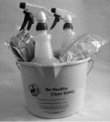
These 17 School Districts in the New York Metropolitan area have either fully
committed themselves; are finishing up or beginning their "testing" phase of this cleaning program. Another half-dozen districts are in their embryonic stage just considering a test. Presently, approximately 30 public districts and private schools have implemented our "HEALTHY & SAFE" Daily
Cleaning program with other interested parties inquiring about it every day.
| Product Type |
Hazardous Ingredients |
How These Can Harm You |
Glass Cleaner
General Purpose Cleaner
Carpet Spot Remover |
A solvent called
"Butoxyethanol" |
Butoxyethanol absorbs
through your skin and poisons your blood, liver, & kidneys. Wear
gloves when you use cleaners with this ingredient. |
| Toilet Cleaner |
Hydrochloric Acid
Phosphoric Acid |
These acids are very
good for removing hard water rings, but they can also blind you in
seconds. Wear your gloves and goggles, or better yet change to a milder
product (one with Citric Acid - strong lemon juice). |
|
Oven Cleaner
Heavy Duty Degreaser
|
Sodium
Hydroxide |
Oven cleaner in a
spray can - very convenient, but also very dangerous. Sodium hydroxide
can blind you, and the vapors can harm your lungs. Use it with care
- wear gloves & goggles, and provide lots of fresh air. |
|
EPA PILOT PROGRAM IDENTIFIES
CLEANING CHEMICAL TOXINS


SANTA CLARA, CA--3/22/01- A joint project between the EPA, California and local officials has found 41 percent of
standard cleaning chemicals are "DANGEROUS" and some are "TOO DANGEROUS TO USE".
The Janitorial Products Pollution Prevention Project found that 6 percent of cleaning products it analyzed were
"so dangerous, that they should not be used" and an "additional 35 percent were dangerous,
"but can be used successfully with extreme care."
The Janitorial Products Pollution Prevention Project is a joint venture of the U.S. Environmental protection
Agency; the California EPA; Santa Clara County; and the city of Richmond, CA.
The project identified some of the most dangerous products as ACID TOILET BOWL CLEANERS; FLOOR FINISH STRIPPERS;
HEAVY-DUTY, HIGH STRENGTH DEGREASERS; SEWER DRAIN OPENERS; and OVEN CLEANERS.
( NOTE: For Safer 'Cleaning Product' Alternatives,
we refer you to:
http://www.cleaningpro.com.
WHERE YOU'LL FIND MORE INFORMATION ON
THE FOLLOWING AREAS OF INTEREST : )
Problem : Acid Toilet Bowl Cleaner
SOLUTION : Non-acid Bowl Cleaner
Go to : "ACID FREE".
Problem : Caustic Floor Finish Stripper
SOLUTION: Non-Caustic Floor Stripper
Go to : "SAFE-STRIP".
Problem : High Solvent Heavy-Duty Degreasers
SOLUTION: Environmentally-Responsible Heavy-Duty Degreasers
Go to :
"BEAN-A-DOO".
"CITRUS JEL DEGREASER".
"ORANGE NATURAL FORCE" (Aerosol).
"SUPERSOLVE".
"WONDER BLUE".
Problem : Caustic Sewer Drain Openers
SOLUTION: Environmentally-Responsible Drain Openers
Go to :
"BIO-REMEDIATOR".
"BIO-BOOSTER".
"ORANGE DRAIN CLEANER".
Problem : Caustic Oven Cleaner
SOLUTION: Environmentally-Responsible Oven Cleaner
Go to : "CITRUS FOAMING OVEN CLEANER" (Aerosol).
As part of the study, an 18-month evaluation of janitors in Santa Clara County was undertaken and found that the
27,000 janitors working in the county sustained approximately 1,200 injuries annually 20 percent of which are
mostly chemical burns to the eyes or skin.
A further review of just 25 percent of the county's janitors found that they used 400,000 pounds of hazardous
materials annually in cleaning, or approximately 60 pounds a year per janitor.
The pilot EPA project is being undertaken in Southern California in an effort to reduce the use of hazardous
cleaning chemicals, the resulting pollution and workplace injuries to janitors and cleaners.
Similar projects are also underway in Massachusetts and Minnesota.
EPA TO MANUFACTURERS: Use Less Toxic Ingredients
NEW YORK — Between 1993 and 1995, the widespread use of household
disinfectants was behind the poisoning of nearly 7500 children under age 6,
researchers say. US Environmental Protection Agency (EPA) researchers are
calling on manufacturers to use less lethal ingredients and improve the safety
of packaging for products including bathroom and kitchen cleaning chemicals
and insecticides. EPA reports that easily accessible disinfectants-all sold as
concentrates-accounted for 93 percent of the poisoning cases. If the products
were diluted to ready-to-use solutions for residential use, they would be
less likely to cause problems, researchers say. American Journal of Public
Health June's issue stated that 1- and 2-year-old children accounted for the
largest percentage of poisonings. The researchers note no deaths were reported.
As a deterrent, one suggestion was using dyes that stain the skin, mouth, urine
or feces of children to alert parents when children have ingested a toxic product.
Researchers also suggested adding a label statement such as: "Products kept
within four feet of the floor where small children may gain access should be secured".
This Article was originally published in
"THE CARBOHYDRATE ECONOMY"
Volume No. 2, Issue No. 4, Spring 2000


University of Minnesota Cleans House
Not long ago, the storage of hazardous chemicals turned heads at the University of Minnesota. In fall 1998, the University’s Facilities Management Division realized that empty and partly filled cleaning product containers were piling up in over 900 janitors’ closets. A University's Safety Technician
witnessed disturbing signs. With custodians cleaning 11 million square feet every day, the container pile-up represented not just a logistical disposal problem but an ongoing employee health threat and a long-term danger to the environment.
In a groundbreaking review for a major university, the University's Environmental Health Specialist , and his colleagues organized the Material Review Board to do a top-to-bottom evaluation of the division’s cleaning products. By winter, the board heard confounding and alarming findings. It learned that Facilities Management purchases nearly 500 different products, many of which were redundant. Worse, the shopping list included 18 varieties of floor strippers that contain some of the most toxic chemicals found in janitorial products. Many ingredients in these petrochemical-based products are listed on the Environmental Protection Agency’s (EPA) toxic chemical hit list, the Toxic Release Inventory (TRI). The handling, use and disposal of these petrochemicals requires strict adherence to EPA and Occupational Safety and Health Administration (OSHA) regulations.
The board decided to clean house. It set two goals: consolidate the number of janitorial products purchased and find safer products. Last spring Facilities Management cut from 500 to 135 the number of approved chemicals it purchases. Then, in winter 1999, the board took another landmark step. The board began exploring the advantages of replacing its petroleum-derived products with less toxic cleaners derived from plant matter. The result is a first for a major university—Facilities Management will phase out its present reliance on the old highly toxic products by 2005, the year its janitorial staff will switch entirely to biobased cleaners.
Made from renewable resources, biobased cleaners avoid petrochemicals altogether. They contain chemical extracts and oils derived from citrus fruits, nuts, seeds and vegetable crops, and range from soy methyl esters to lactic acid esters and dimethylsulfoxide. Case studies show that biobased cleaners easily meet or exceed the performance of petrochemical ones.
Several reasons prompted the university’s decision to kick the petrochemical habit. It's Project Coordinator Zone Manager foresaw the inevitable enactment of stricter regulations requiring the use of less toxic chemicals. Many petroleum-based solvents and cleaners contain chemicals that are on the EPA’s TRI list, and that list is expected to grow. So rather than replace existing toxic petrochemicals with other petrochemicals that have the potential to end up being regulated, the Project's Coordinator's Team wanted a long-term solution. Because of reduced health and environmental dangers, chemicals derived from plant matter are not listed, nor are likely ever to be listed, on the EPA’s TRI list. The Project's Coordinator and his colleagues agree that making the shift to less toxic products protects the health and safety of the university’s employees, students and surrounding environment.
The change also makes economic sense. Petrochemical-based ingredients carry hidden costs, starting with training. Large institutions typically spend more when they have to train their employees in the proper handling and use of products that fall under EPA and OSHA regulations. At the University of Minnesota, this cost was felt acutely. Given the scope of its custodial needs, Facilities Management has organized the school—one of the nation’s largest land grant universities, straddling both banks of the Mississippi River—into six geographical zones. The profusion of some 500 products was complicated enough, but further complicating matters was that different products were in use from zone to zone. Every time employees transferred to a new assignment, they had to be retrained. The Project's Coordinator calculated that by standardizing the use of janitorial products across all zones, the university will save around $20,000 per year in their training program alone.
And the costs continue even when the petrochemical products are used up. Federal and Minnesota state regulations strictly govern the disposal of hazardous petrochemical products, something that does not come cheaply for a large institution. Accounting for the presence of TRI-listed cleaning products, the Project's Coordinator estimates that the university pays an average disposal cost of $250 for each container with unknown content—a sum much in excess of what many of the products cost before being opened. Containers range from one quart to a 55-gallon drum and volume of disposed content varies, making it difficult to calculate the disposal cost per gallon. By switching to bulk mixing systems and reducing the number of individual container purchases, the university stands to benefit from substantial cost savings.
Embarking on a complete overhaul of outmoded, unsafe product procurement isn’t easy, but the University's Facilities Management Division are optimistic about the benefits. Custodians have already voiced their approval of using safer biobased products.



THE LATEST FACTS YOU SHOULD KNOW IN 2002
According to the MAY 2002 issue of the cleaning trade magazine--"CM Cleaning & Maintenance Management magazine"--( National Trade Publications, Latham, New York, 12110 ), an article entitled,
"GREEN Cleaning Gets A Federal Push", clearly states on page 51 :
"...the U.S. Environmental Protection Agency ( EPA ) is urging federal agencies to adopt so-called "GREEN" cleaning practices and purchase environmentally-safe cleaning products...
Next in line will be state and local governmental agencies across the country, industry experts said...".
ENVIRONMENTALLY-PREFERABLE PURCHASING (EPP)...
is a federal-wide program that encourages and assists Executive
agencies in the purchasing of environmentally preferable products and services.
What is "environmentally-preferable?"... products or services that have a lesser or reduced effect on human health and the environment when compared with competing products or services that serve the same purpose..."- Executive Order
13101
Why purchase environmentally-preferable products and services?
- Did you know that the United States consumes approximately 25% of the world's resources
with only 5% of the world's population?
- Did you know that the U.S. federal government is the single largest consumer of goods and services in the U.S., and
probably, in the world? , ... spending more than $200 billion annually on goods and
services! The federal government also spends an additional $240 billion a year,
indirectly, through grant disbursements. EPA recognizes the influence the United
States, and in particular, the U.S. government, has on what products and
services are produced due to this tremendous purchasing power. EPP works to
leverage that influence to minimize environmental burdens.
The Benefits of Environmentally-Preferable Purchasing
Improved ability to meet existing environmental goals
Improved worker safety and health reduced liabilities
Reduced health and disposal costs
The Requirements of Environmentally-Preferable Purchasing
All federal procurement officials are required by Executive Order
13101 (PDF 96 KB) and Federal Acquisition Regulation (FAR) (Text file 30 KB) to
assess and give preference to those products and services that are
environmentally preferable.
On September 14, 1998, President Clinton signed Executive Order (EO)13101, entitled "Greening the Government through Waste Prevention, Recycling and Federal Acquisition". Executive Order 13101 (EO 13101) supersedes EO 12873,
Federal Acquisition, Recycling and Waste Prevention, issued on October 20, 1993, but retains a similar requirement for the U.S. Environmental Protection Agency (EPA) to develop guidance to "address environmentally preferable purchasing."
(Section 503, EO 13101)
The Final Guidance that follows is based on EPA’s September 1995 Proposed Guidance on the Acquisition of Environmentally Preferable Products and Services (60 FR 50721, September 29, 1995) and comments received on that
Proposed Guidance as well as lessons learned from pilot projects conducted to date.
The Final Guidance is designed to help Executive agencies meet their obligations under EO 13101 to identify and purchase environmentally preferable products and services. Section 503 (c) of EO 13101 directs Executive agencies to
"use the principles and concepts in the EPA Guidance on Acquisition of Environmentally Preferable Products and Services, in addition to the lessons from the pilot and demonstration projects to the maximum extent practicable, in identifying
and purchasing environmentally preferable products and services" and "modify their procurement programs as appropriate". Furthermore, Section 23.704 of the Federal Acquisition Regulation requires agencies to "affirmatively
implement" the objective of "obtaining products and services considered to be environmentally preferable (based on EPA-issued guidance)".
"Environmentally preferable" is defined in Section 201 of EO 13101 to mean products or services that "have a lesser or reduced effect on human health and the environment when compared with competing products or services that serve the same purpose. This comparison may consider raw materials acquisition, production, manufacturing, packaging, distribution, reuse, operation, maintenance or disposal of the product or service".
Implementation of the Final Guidance will draw on the procurement experience of the Executive agencies and on the environmental expertise of EPA and other organizations both within and outside of the Federal government. This guidance provides a broad framework of issues to consider in environmentally preferable purchasing and will help Executive agencies systematically integrate environmental preferability principles into their buying decisions.
Executive Order 13148 - Greening the Government Through Leadership in Environmental Management
The new Executive Order 13148 - Greening the Government through Leadership in Environmental Management - was signed on April 21, 2000. The Executive Order requires federal agencies to incorporate environmental management systems into agency day-to-day decision-making and long term planning processes. Pollution Prevention is highlighted as a key aspect to the environmental management system process.
Executive Order 13101 - Greening the Government Through Waste Prevention, Recycling, and Federal Acquisition
On September 14, 1998, President Clinton signed Executive Order 13101, entitled "Greening the Government through Waste Prevention, Recycling and Federal Acquisition." Executive Order 13101 supersedes EO 12873, Federal Acquisition, Recycling and Waste Prevention, issued on October 20,1993. This Executive Order requires executive agencies to incorporate waste prevention and recycling into the agency’s daily operation. It also asks executive
agencies to work to increase and expand markets for recovered materials through greater Federal Government preference and demand for such products.
Executive Order 12873 - Federal Acquisition, Recycling and Waste Prevention
This Executive Order directs federal agencies to evaluate the environmental attributes of the products and services they purchase.
EPA/742/Z-93/001
October 1993, Overall Approach for Implementing Executive Order 13101,
Section 503 of EO 13101 has two key components:
(1) development of this guidance; and
(2) implementation of the guidance through pilot and demonstration projects. This guidance sets a broad policy framework for implementing environmentally-preferable purchasing within the context of Federal government. For the second component, Section 503 (b) of the EO states "[A]gencies are encouraged to immediately test and evaluate the principles and concepts contained in the EPA’s Guidance...through pilot projects...".
These pilots may be undertaken using the in-house expertise of EPA and other Executive agencies, as well as the technical expertise of nongovernmental entities, including, but not limited to, voluntary consensus standards bodies (see§ 12(d) of the National Technology Transfer and Advancement Act (Pub. L. 104-113, §12(d), 15 U.S.C. 272 note), environmental standard setting organizations, third party certification programs, environmental
labeling or environmental "report card" programs, and other environmental consulting organizations. Section V of this Final Guidance provides more detail about how these pilot projects might work. These pilots are expected to yield more specific and practical information about applying this Final Guidance to purchases of particular products and services.
In addition to promoting environmentally-preferable purchasing, EO 13101 encourages Executive agencies to purchase bio-based products. (Section 504 (b)). Under the EO, "biobased product" means "a commercial or industrial product (other than food or feed) that utilizes biological products or renewable domestic agricultural (plant, animal and marine) or forestry materials."
Bio-based products may also be environmentally-preferable. Made from renewable resources by definition, these products have many positive environmental aspects and should be considered by agencies looking to make environmentally preferable purchases. However, Federal purchasers should not assume all bio-based products are automatically environmentally-preferable. As with other products, Executive agencies should consider a range
of environmental impacts associated with bio-based products when making purchasing decisions. In some cases, factors such as pesticide use or high water consumption might make a bio-based product less environmentally-preferable. The list of bio-based products which the U.S. Department of Agriculture will issue under Section 504 of EO 13101 will be a good starting point for Executive agencies looking to identify environmentally-preferable
purchasing. During the development of pilots under Section 503 (b) of the EO, EPA will look for opportunities involving bio-based products.
"GREEN" Cleaning Product Attributes
Natural Resource Use
-Avoidance of nonrenewable resources, such as petroleum-or hydrocarbon-based materials*
-Use of renewable resources, such as biobased citrus, seed, vegetable, and pine oils.
Manufacturing/Product Content
Some organizations have applied these criteria to substances used in the manufacturing process as well as the final product.
-Company's environmental policy and reputation
-Absence of potentially harmful chemicals, such as:
1. Irritating artificial dyes and/or fragrances
2. Substances classified as known or likely human carcinogens by authorities such as the National Toxicology Program, the US EPA, or the International Agency for Research on Cancer
3. Ozone-depleting compounds
4. Chemicals listed under the State of California’s Safe Drinking Water and Toxic Enforcement Act (Proposition 65) as causing reproductive toxicity)
5. Regulated hazardous materials (e.g. products classified as hazardous waste; products that trigger OSHA hazard communication requirements)
Product Packaging
-Concentrated formulas*
-Reduced packaging
-Packaging designed to reduce exposure to product
-Recyclable packaging
-Recycled-content packaging
-Refillable bottles
-Pump sprays rather than aerosols*
-Products shipped in bulk
Product Use
-Acute toxicity - usually defined in terms of a single dose or short-term air concentration that can cause lethality (LD 50 /LC 50 )
-Effects on air quality (VOC content)
-Chronic toxicity (includes a wide variety of adverse effects that can result from long-term exposure to a substance)
-Corrosiveness (pH)
-Flashpoint (a higher flashpoint indicates a lower potential for flammability/combustibility; liquids with a flashpoint below 100 degrees F are considered flammable)
-Likelihood of exposure to concentrate
-Skin and eye irritation potential
-Effective with cold water instead of hot, which will help reduce energy use
Product Disposal
-Aquatic toxicity
-Biodegradability
-Hazardous waste classification (is the product considered a RCRA hazardous waste by one or more criteria, e.g. acute toxicity, corrosivity, etc.?)
*More Information...
-The consumption of petroleum, a nonrenewable resource, to be used for energy during manufacture and/or as a product
component, can serve as an indicator of acid rain, climate change potential, air pollution, and associated human health risks, as well as risks to endangered species and fragile ecosystems.
-Choose pump spray containers instead of aerosols. Pressurized aerosol products are usually high in VOC content. Aerosol propellants often produce a finer mist, so the product can more easily be inhaled by workers. Aerosol containers may be hazardous to workers if punctured. Also, any hazardous product left in an aerosol container makes the entire container a regulated hazardous waste, which means more expensive disposal.
-In general, concentrated formulas are preferred because they reduce the amount of packaging and reduce the amount of energy used in shipping the product. However, concentrated products can present hazard issues that must be addressed to ensure worker safety and proper disposal.
-Disinfectant products serve an important function in certain areas. However, many of these products can present health or ecological concerns. Disinfectant products should be limited to applications where it is important to control infectious agents. Many types of general purpose cleaning do not require the use of disinfectants.
Guiding Principle(s):
For More Information, go to : http://www.epa.gov/oppt/epp/guidance/finalguidance.htm#GuidingPrinciple1
Environment + Price + Performance = Environmentally Preferable Purchasing
Environmental considerations should become part of normal purchasing practice, consistent with such traditional factors as product safety, price, performance, and availability.
The manufacture, use, and disposal of certain products might have adverse impacts on human health and the environment. These impacts impose costs that the purchasing entity, and ultimately, society as a whole, end up paying for in one way or another. For the Federal government, the hazardous or toxic nature of a product or service can result in significant cleanup or liability costs, as well as in less directly quantifiable,
but cumulative and persistent environmental damage. Even non-hazardous waste is associated with ever-increasing disposal costs that can be avoided or reduced. Responsible management, beginning with the initial purchase of products and services that minimize environmental burdens, can diminish the Federal government’s raw material, operating, maintenance, and disposal costs. In addition, a product or service’s environmental
preferability can often have positive impacts on its overall performance.
For these reasons, the Federal government’s purchasing decisions are no longer confined to considerations of price and functional performance but should include considerations of environmental performance as well. Today agencies can obtain improved environmental attributes not at the expense of, but instead may operate in concert with, other traditional factors like price and functional performance. Those product or service
providers who can optimize all these factors will capture and maintain the largest market-share of government customers.
Just like price, performance, and health and safety, environmental factors should be a subject of competition among vendors seeking government contracts. In turn, this increased competition among vendors should stimulate continuous environmental improvement and increase the availability of environmentally preferable products and services. The purpose of this guidance is to encourage Executive agencies to award contracts to
companies that take environmental concerns into account. This process, consequently, will lead to the development of environmentally preferable products and services that perform better and cost less because they reduce waste and negative environmental impacts. As stated, this principle reflects the spirit of a number of reinvention initiatives at EPA and across the Federal government aimed at testing cleaner, cheaper, and
smarter approaches to environmental protection.
Agencies have considerable discretion in incorporating environmental preferability into procurement decisions, especially within the context of "best value" contracting. For example, environmental considerations that result in payment of a price premium for goods or services may be reasonably related to an agency’s definition of its "minimum needs" and, therefore, may be permissible. This is not much different than paying a
higher price for better performance or quality. Federal personnel may consider paying a reasonable premium for environmentally preferable products on a number of grounds. For example, a reasonable price premium may be justified because the environmental attributes of a product or service provide offsetting reductions in operating and disposal costs.
FOR MORE INFORMATION, GO TO :
http://www.epa.gov/oppt/epp/pubs/13101. pdf
TODAY'S PREVAILING
INDOOR ENVIRONMENTAL CONDITIONS
ARE YOU,
AND YOUR CHILDREN,
BEING EXPOSED TO UNNECESSARY
"TOXIC & HAZARDOUS" SUBSTANCES
EVERY DAY
IN YOUR WORKPLACE/SCHOOL/
HOME ENVIRONMENTS?
CHEMICALS-N-KIDS

**Why are we concerned about the cleaning chemicals in your workplace, child's school, or home??
Read on and then MAKE A CHANGE to environmentally "GREEN" responsible
cleaning products. It just makes sense to do it! WHY are you waiting? If you
feel that present conditions are affecting the health & welfare of you and your
family, MAKE A DIFFERENCE! Your Influence COUNTS....USE IT!!
FIVE ( 5 ) BASIC "SHOCKING" FACTS :

- # 1 ) Allergic reactions to "Sick" Indoor Environments account for
more than
10 million workdays missed by U.S. employees each year.
- # 2 ) Allergic reactions to "Sick" Indoor Environments keep
10, 000 American children out of school each day
- # 3 ) A U.C.L.A. study indicates that "adverse health effects have been identified
regarding common chemical ingredients found in 222 cleaning products."
- # 4 ) According to a latest medical report , conventional cleaning chemicals are
NEUROTOXINS which may impair a child's developmental and learning abilities.
- # 5 ) Forty-one ( 41 ) percent of Health-related "housekeeping" complaints are related
to
airborne indoor dust and the by-products of breeding dust mites.
IF YOU THINK THESE "SHOCKERS" WERE REAL EYE-OPENERS ,
READ ON...

( National Trade Publications,Inc., Latham, N.Y.,
copyright, 2001) .
( A PERSONAL NOTE: the cleaningpro )
Years ago, when "HEALTHY CLEAN BUILDINGS®" was preaching its dedication to
the replacing of existing,'toxic' and 'hazardous' cleaning chemicals with
environmentally-responsible, reduced-toxicity alternatives , we got
"THE LOOK" from most facility managers. The select few understood
the message, most were skeptical and cynical, and the remainder were
just plain "Archie Bunkerish" about it.
In the July 2001 editions of diverse publications such as GOOD HOUSEKEEPING
and Cleaning & Maintenance Management (CM), it was reported simultaneously
on the possible poisoning of the human body with cleaning chemicals.
It's very gratifying to know that us "alarmists" , "healthnuts",
"wackadoos", and "extremists" seem to have been just ahead of
our time regarding these common sense cleaning issues !! Mainstream America is
finally being educated through the mass media about the health issues regarding
cleaning chemicals. Perhaps... WE, "THE CONCERNED" can NOW urge FACILITY MANAGERS to :
PLEASE STOP POISONING OUR INDOOR WORK ENVIRONMENTS !
It seems that Facility Managers, especially in schools ( where children's welfare are at stake ), do not wish to see the
larger picture or trends regarding this issue...so please allow us to drive the point
home. Presently, the E.P.A.'s Tools for Schools Action Plan is recognized as a
voluntary program for implementation at the discretion of the public school district.
However, industry experts predict that these guidelines will be mandated by the year
2005-06 after it is shown that most school officials just don't seem to care about its
implementation. Additionally, advocacy groups---like the "Healthy School Network",
"Beyond Insecticides", and such--- are justifiably educating the general public and
politicians of necessary legislation to safeguard children in indoor school environments.
For example, here on Long Island, New York, a large school district recently chose a
proven "toxic and hazardous" , nationally branded, proprietary "Cleaning Solution Center"
System district-wide over our accredited "HEALTHY & SAFE" Daily School Cleaning
Program ALTHOUGH OUR PROGRAM is STILL being introduced in this same district ONLY in school
buildings where parents have shown concern regarding the health and safety of their
children regarding cleaning chemicals and the over-all school environment. What
hypocrisy ! Although our program is used in this district, it serves only as a tool to
appease "complaining parents". In those buildings where our program is being instituted,
the head custodians are reporting better cleaning results, a sense of a healthier
environment, economy of scale, lower chemical consumption, and a reduction in
spending. In fact, custodial eyebrows are being raised regarding their supervisors'
lack of concern over their own health and safety by choosing a "toxic" system over
a proven healthier one. In this instance, old vendor loyalties won over the best alternative
to serve the health interests of the district's students, teachers, and staff. Incredulously,
these same facility managers can look parents straight in the face and state that the
" health and safety" of their children are their department's # 1 priority.
In short, the ammunition is being presented to the general public in widely read
magazines and viewed news shows with the facility manager as its target.
Unless facility managers are wearing bullet-proof vests, WE, as building occupants and inhabitants of the
indoor environments MUST DEMAND cleaning product evaluation program regarding the health and safety of
existing cleaning programs, especially since WE "live and work"; and "breathe
the air" within these workspaces each and every day.

INDOOR AIR QUALITY
I.A.Q.
INDOOR AIR QUALITY (I.A.Q.) has become a hot topic among health-oriented groups and agencies.
Organizations like the U.S. Environmental Protection Agency (EPA),
the American Lung Association, the World Health Organization, and the
National Heart, Lung, and Blood Institute have adopted or are adopting IAQ
policies. According to the EPA website, "the EPA and its Science Advisory
Board have consistently ranked indoor air pollution among the top five
environmental risks to public health." EPA statistics show levels of many
airborne pollutants may be two to five — to even 100 times — higher indoors
than outdoors, a noteworthy fact since most Americans spend 90 percent of
their time inside.
According to the American College of Allergy, Asthma and Immunology, 50
percent of all illnesses are caused by or aggravated by polluted indoor air.
U.S. Department of Energy studies suggest that improving building environments
would reduce health care costs and sick leave while increasing worker
performance for a productivity gain of $30 to $150 billion annually.
Additionally, a recent report by the UCLA Pollution Prevention Education and
Research Center, "Adverse health effects have been identified for a number of
[common chemical ingredients found in 222 cleaning products] ... For example,
reproductive toxicity [e.g.,infertility] has been associated with ethylene glycol
methyl ether and ethylene glycol ethyl ether, while the most widely used
compound, EGBE (ethylene glycol butyl ether), contained in 22 percent of the
sample products, is a "suspected carcinogen." The environmental and occupational
hazards associated with many of these chemicals are not well understood, but the
center’s director, Robert Gottlieb, cites "increasing concern because they are sources
of indoor air pollution and multiple occupational exposures, and...may be released...
into the ambient environment."
Other studies show improper dust collection leaves behind contaminants like dust
mites, dead skin cells, chalk dust, virus-laden particles, pet dander, soil, clothing
fiber, carpet fragments, mold, bacteria, and insect parts which may contribute to
chronic headaches, sinus congestion and infection, sore throat, asthma and
fatigue.
CLEANING CHEMICAL PRODUCTS MAY AFFECT BRAIN FUNCTIONS!!

By Caren Benjamin
The Associated Press
Washington, May 12, 2000 - A pregnant woman who spends a few hours
on a home-improvement project may unwittingly be putting her child at risk for
problems ranging from hyperactivity to autism, a group of Boston-area
doctors said in a report. The reason is chemical ingredients found in common household cleaning chemical products
like solvents and pesticides. No one knows how dangerous they are to human brain development
because the government doesn't require companies to perform such
tests before bringing products to market, the "Greater Boston Physicians for Social
Responsibility " said in a report recently released. Tests on animals show there is
cause for concern about products ranging from glue to flea collars to nail polish, said
the report by the group, an affiliate of the Nobel Peace Prize-winning national "Physicians
for Social Responsibility ". The Boston organization said the federal government should
start requiring tests to ensure chemicals do not harm human brain development.
The EPA currently is considering restricting use or dosage of the
pesticides Dursban and Lorsban because of concerns about the products'
effects on children. Both are used in a range of products from lawn
insecticides to flea collars for pets.
Here Are The Facts:
CONCERNS:
MEDICAL REPORT LINKS CLEANING AGENTS TO DISORDERS!
HARRISBURG,PA — Cleaning compounds and pesticides are among the
chemicals listed in a report linked to developmental disabilities,
including behavioral and learning disabilities.
"The Clean Water Fund" and "Physicians for Social Responsibility"
released a study on May 11, 2000, "In Harm’s Way," a study of lead,
mercury, cadmium, and manganese; pesticides; dioxins and PCBs; solvents
used in gasoline, paints, glues and CLEANING CHEMICALS; nicotine
and alcohol.
The report conclusively found that one million children in the United
States now exceed the accepted level above which lead affects behavior
and cognition. The report also found that over 80 percent of adults and
90 percent of children in the United States have residues of one or more
harmful pesticides in their bodies. Experts conclude that it is
critical that we understand the impact of these neurotoxic chemicals on
developmental and learning disabilities. The urgency of this issue is
underscored by the fact that between 5 percent and 10 percent of school
children in America have learning disabilities, and at least an equivalent
amount have ADHD,” (attention deficit hyperactivity disorder). The concerns
raised by this report suggest the need for a new precautionary approach
that protects the health of future generations by reducing exposure to these
neurotoxicants. One obvious place to start this awareness is by passing
state legislation that would reduce the use of pesticides in our schools,
making sure that the school environment doesn’t put our children in
harm’s way.
HEALTHY SCHOOL NETWORK SPEAKS OUT!
ALBANY, NEW YORK, June 2, 2000-Healthy Schools Network routinely
deals with sick kids and sick adults in sick schools. The clock is ticking on
kids and there are no easy answers.
Our Info and Referral Services have guides, literature,
factsheets to help schools and parents cope. Too many schools are stuck in
the dark ages of BAD-OLD-CHEMISTRY and haven't done cost-effective
"GREEN" product switches.
Last month we released a survey report of NYS school nurses,
finding that 71% knew children in their buildings whose health and learning were compromised
due to indoor pollution. Nurses, like other school employees, are reluctant
to share environmental bad news with parents.
Claire Barnett
Executive Director
Healthy Schools Network, Inc.
http://www.healthyschools.org
e-mail : info@healthyschools.org

"NURSES REPORT "SICK BUILDINGS", KIDS AT SCHOOL"
Reprinted from: "CM Cleaning & Maintenance Management Magazine",
National Trade Publications, 13 Century Hill Drive, Latham, New York,
12110; July, 2000 Issue; page 40; Article entitled:

"Seventy-one (71) percent of 200 nurses from across NEW YORK STATE
reported that they know of children in their schools whose learning or
health was affected by polluting products in the building: including,
PESTICIDES, BATHROOM DEODORIZERS, and other "TOXIC" CLEANING PRODUCTS.
( The following excerpts were taken from ‘CM NEWS DAILY’-an electronic news service
from ‘Cleaning & Maintenance Management’ and ‘Cleanfax’ magazines, published by
National Trade Publications,Inc., Latham, N.Y., copyright, 2001) .
Dateline : July 26, 2001
CUSTODIANS:

IS YOUR JOB KILLING YOUR CHILDREN ?
NEW YORK : Custodians may unwittingly be placing their children's health in
jeopardy, a new study indicates.
The study released this month in the American Journal of Epidemiology indicates
that on-the-job exposure to certain substances, including lacquer thinner, turpentine,
diesel fuel and wood dust, may increase the chances his children will develop
childhood cancer.
The study reports that a higher prevalence of neuroblastoma (the third most common
childhood cancer) in the children of fathers who were exposed to these chemicals
and other hydrocarbons repeatedly on the job.
Neuroblastoma occurs in infants, children and, very rarely, adults. It is a quick-growing
cancer that arises in nerve tissue. By the time it is diagnosed, the disease has usually
spread to the lymph nodes, lungs, liver or bones. Treatment involves a combination of
surgery, radiation, chemotherapy and bone marrow transplant.
The study which looked at 472 fathers of children under the age of 19 who have the
disease and 445 fathers of healthy children - found exposure to turpentine increased
neuroblastoma risk more than 10-fold, while men exposed to lacquer thinner were
3.5 times as likely to have a child with neuroblastoma.
One possible explanation for the finding may be that the chemical exposure damages
a man's sperm, the authors speculate.Researchers are calling for more research
on the topic.Earlier research had also indicated an occupational connection. Research
has also indicated a link with the termite pesticide chlordane and the cancer.
The cleaning industry's "CM e-News Daily" and its parent magazine--"CM Management"--(both widely read trade
news leaders) has repeatedly warned of the potential health dangers certain
ingredients in cleaning chemicals pose.
STUDY PROBES CANCER WITH CHEMICAL LINK!
NEWTON, MASS. — On May 16th, one day after the release of a study linking
cleaning compounds and pesticides to behavioral disorders in children (see
above), the non-profit research group, "Silent Spring Institute (SSI)" says
it will prepare a study to develop guidelines for testing of chemicals found
in household cleaners and furniture finishes that may cause breast cancer in
women. The study will compile a list of chemicals already identified as causing mammary tumors
in animals and will develop guidelines for how additional chemicals should be tested.
About 100 compounds have been identified as priorities for breast cancer research
because they cause mammary tumors in animals. Researchers suspect human breast
cancer may be related to these compounds, pollutants found in household products,
including some cleaners, furniture finishes, and pesticides. With breast cancer affecting one
out of eight women, this new study is designed to examining environmental
links to cancer and especially breast cancer.
( The following excerpts were taken from ‘CM NEWS DAILY’-an electronic
news service from ‘Cleaning & Maintenance Management’ and ‘Cleanfax’
magazines, published by National Trade Publications,Inc., Latham, N.Y.,
copyright, 2001) . )
Dateline : July 10, 2001
SEARCH FOR DISEASE,
SOLVENT LINK TAKES SPOTLIGHT
LATHAM, NY — There is rising speculation that products such as those used in paint
stripping for years — still employed in commercial applications — are responsible for
a variety of health problems.
Some of the same solvents have been used in carpet cleaning specialty products,
floor strippers, degreasers, toilet bowl cleaners and other applications for years.
The United States Air Force has become a leading edge in the replacement of volatile
solvents with low-toxic and non-toxic alternatives. Even as contractors serving airplane
manufacturing and maintenance companies continue to use volatile, corrosive solvents,
higher military standards in bid specs demand "alternative" solvents — petroleum-based
products processed to reduce toxicity or phytochemicals. These products do the same
job; however, they require more "dwell" time.
However, Good Housekeeping — widely read by the same people who call on carpet
cleaning professionals to clean their home carpets — speculates on a possible link
between the strong solvent-based strippers once used on military aircraft, jet fuels,
paints, etc. and an unusually high incidence of a rare disease and various cancers.
AS SEEN ON NBC NBC NIGHTLY NEWS WITH TOM BROKAW
Feature Story with Robert Bazell, NBC Correspondent, Lifeline


May 29, 2001--"IT’S VERY obvious to anyone who practices in the field of allergy
that there are many patients who walk around who are misdiagnosed," recently stated a noted allergist
at Mount Sinai Medical Center in New York.
To find out just how many patients fit into that category, a professor of pharmacy administration
at Ohio State University studied 265 patients taking medications for allergies.
Fully 65 percent did not suffer from allergies, the study found.
An allergic reaction occurs when a foreign substance in the environment such as pollen, cause cells in our bodies to
release a chemical called histamine that causes inflammation of the nose and eyes. Anti-allergy
drugs block the histamine, but don’t do anything if there is no such reaction.
The common cold, exposure to chemicals, and a condition called "sinusitis" can all cause allergy-like
symptoms even if there is no allergy.
( NOTE : Exposure to scented personal care and cleaning chemical products
can cause body cells to "load up" with superfluous "toxic"
chemicals. This condition can trigger and escalate cases of Multiple Chemical Sensitivities;
not to mention, Asthma; various Cancers, and other proven, chemically-related diseases. ).
People who are misdiagnosed can waste many dollars for prescription drugs, taking medicines they don’t
need. And although side effects are rare, the medications fail to
solve the real problem. Only skin testing can reveal definitively
if a person is truly allergic. While the process is time-consuming
and expensive, for millions, it could cost less than unnecessary
prescription drugs.
According to the "American Academy of Allergy, Asthma, & Immunology", an allergic reaction
is the body's immune system reacting inappropriately to foreign substance. The immune system perceives the
foreign substance as dangerous and invasive which triggers an adverse reaction.
Here is HOW an Allergic Reaction Occurs
#1 ) Airborne ALLERGENS ( in the form of mold, dander, pollen, chemical fumes, and such )
enters the eyes, nose, and lungs where they provoke the immune system to produce Immunoglobulin E
( IgE ) antibodies.
#2 ) The IgE antibodies coat the surface of basophils ( circulating white blood cells ) and mast cells
( another type of immune cell that lines the airways ). When allergens subsequently enter the body,
they bind to these antibodies. This prompts the basophils and mast cells to take action.
#3 ) Basophils and mast cells release a torrent of body chemicals, including histomine and
leukotrienes. These pro-inflammatory chemicals are what cause allergic symptoms.
# 4 ) This chemical cascade can lead to runny eyes and nose; congestion; sneezing; itchy eyes and throat.
In the lungs, this reaction can cause swelling in the lining of the airways and mucous secretion-
leading to wheezing and severe coughing.
LATEST MEDICAL RESEARCH: Avoid Allergens for Life-long Health!
NEW YORK — Cleaners who stress the health benefits of their service should note a
report in May 2000's "Annals of Allergy, Asthma and Immunology", which says avoiding
allergens early in life can decrease the risk of developing asthma. A researcher
reports that adults with hay fever or other allergies are up to three times to develop
asthma those who don’t display those symptoms.Increasing age raises the likelihood
of developing asthma, researchers note. However, asthma symptoms can decline in
people diagnosed with the respiratory ailment at a young age.
Another report says nearly half of all Americans are in line for a
heavy dose of allergens as they settle down for a good night’s sleep. The National
Allergen Survey of 831 homes across the US, conducted by the National Institute of
Environmental Health Sciences (NIEHS), found that the bedding in over 45 per cent of
them contained at least two micrograms of dust-mite allergen per gram — enough to
cause allergies to develop. The American Lung Association reports that more than 23
per cent of homes have dust-mite allergen levels of 10 micrograms per gram — enough
to cause asthmatic symptoms.
( We thank Ms. Ellen Weininger, Healthy School Network, for the following contribution )
ASTHMATIC TRIGGERS
SUBSTANCE % OF ASTHMATICS
TRIGGERED BY SUBSTANCE
INSECTICIDE 85%
HOUSEHOLD CLEANERS 78%
PERFUME/COLOGNE 72%
CIGARETTE SMOKE 75%
FRESH PAINT 73%
CAR EXHAUST / GAS 60%
COOKING ODORS 37%
BODY ODORS 20%
MINT 10%
Source: Shim, Chang, M.D., Williams, M. Henry, Jr., "Effects of Odors on
Asthma." The American Journal of Medicine, Volume 80, January 1986, pp. 18-22
HOUSEHOLD ALLERGENS
UNDER CHILDREN'S ASTHMATIC ATTACK !

WASHINGTON--3/7/01-- Focusing on results from a study published in the Pediatrics Journal pointing out the
HARMFUL EFFECTS of HOUSEHOLD ALLERGENS on children suffering from asthma, the Soap and Detergent Association
(SDA) is urging frequent cleaning to control allergens.
The SDA refers to a new study by the Children's Hospital Medical Center of Cincinnati concluding that elimination
of household allergens could result in a reduction of childhood asthma cases of almost 40 percent.
The leading "triggers" of asthma includes tobacco smoke, dust and dust mites, animal dander, pollen,
cockroaches, chemical residues and mold & mildew.
Health professionals agree that cleaning is one of the most important ways of controlling indoor allergens
and reducing symptoms for people with asthma. They also advise to adapt lifestyle strategies to help prevent exposure to allergens
that can cause asthma.



So you know...outdoor dust is nothing more than powdery, dry dirt. Contrary to most understandings,
indoor dust is an amalgamation of allergic triggers. It is a microscopic mix of dry skin, pet dander,
insect parts, dead sneezed viruses, soils, clothing fibers, carpet fragments, molds, and bacteria
(just to name a few). An estimated 80% of indoor dust consists of "skin fluff". "Skin fluff"
is the broken off skin particles that are constantly shed from the skin's surface. The average person loses about 10 pounds
of dead skin each year. These kerantized cells, which are pushed off by new cells in the dermis layer about every 12 weeks, provides an endless food supply
to microbial and insecticidal invasion. Along with free roaming insects such as silverfish, spiders, flies, ants,
and mosquitoes, the dastardly, microscopic, dust-related insect, DUST MITE, known as 'Dermatophophagordes Pteronyssimus',
is acknowledged as one of the biggest breeders in this type of dust. Dead human skin is THE primary source of food for dust mites. Measuring approximately
0.01 of an inch long, the dust mite enjoys the warmth and moisture of a "sealed" indoor environment and an endless supply of "skin" meals.
For reference purposes, a "just" washed pillowcase can easily result in a head count of 10,000 mites.
However poor cleaning practices can easily result in 400,000 mites.
Although the indoor dust and mites themselves are allergic triggers, the culprit creating "REAL" allergy problems
are the bodily functions of the dust mite. It's fecal droppings create and magnify all of the allergic conditions
associated with dust allergies including respiratory congestion, chronic headaches, fatigue, sinus infections, sore throat, or asthma. EACH DUST
MITE LEAVES BEHIND ABOUT 20 PELLETS OF FECAL MATTER PER DAY !!...so do the math from the example provided above: 400,000 (on just
a poorly cleaned pillowcase) X 20 fecal droppings per day = 8 million fecal
droppings per day. Each pellet measures about 10 to 24 microns in size. To put that in perspective, the diameter of the human hair measures 80-100 microns. Imagine what a large carpeted area is festering when
compared to a meager pillow case.
Statistically, 2 out of 10 people (with children it is almost doubled) are automatically "allergic to" and "affected by" something
within their environment. In many cases, dust mite fecal droppings is the "allergic trigger" within an enclosed indoor environment, even
more so than dust and the dust mite itself.
Allergies seem trivial to people who don't have them...but, their effects, such as eye itching, nasal congestion,
coughing, hives, vomiting, and diarrhea are NOT being created by one's
imagination or fantasies. Whatever form an allergy takes, the symptom is the same: THE HUMAN BODY REACTS AS IF UNDER
ATTACK BY A DISEASE-CAUSING PATHOGEN. When dust is disturbed through feather dusting, dust mopping, regular
vacuuming, the allergic-proned individual is walking through a "dust cloud"
of "dried skin, insect parts, dust mites, and fecal droppings". No wonder
WHY he/she feels "SICK".!!
This microscopic pest is followed right behind by "mold & mildew" and "chemical residues" (NOT necessarily in that order)
as KEY areas to address. By just focusing and improving these 3 key areas, any facility or home will take on an entire "healthier" outlook.
The prime consideration is that ALL cleaning, and especially, carpet cleaning, MUST PROMOTE HEALTH, and not just
cosmetic appearance. By identifying, planning, and focusing on these factors, all of us will be able to "breathe easier" indoors.
IRRITANT DUST/ALLERGIC TRIGGERS/& DUST MITES

A REPORT from
WASHINGTON — "The Institute of Medicine reports microscopic dust mites inhabiting
carpets and bedding can cause children with susceptibility to develop full-blown asthma,
which affects approximately 17.3 million Americans. The number of cases of asthma, which
leaves sufferers coughing, wheezing and gasping for breath, has risen about 75 percent since
1980, according to the Institute. The rise is among blacks and poor, inner-city populations.
The fact that dust mites are present in nearly everyone eliminates them as sole cause of asthma.
But in children genetically susceptible to asthma, exposure to dust mites can lead to the disease,
the report says. Secondhand smoke may prove to be a similar trigger for young children.
It suggests eliminating fabric upholstery, carpets, pets and smoking and exterminating cockroaches.
Controlling humidity is particularly important, because dust mites and cockroaches thrive in humid conditions.
Doctors have long warned that certain allergens can worsen asthma, triggering or
exacerbating attacks of breathlessness. The report may serve as a practical guide to asthma
effectors in the indoor environment and suggests practical steps to ease symptoms. It concludes
dust mites, cockroaches, cat dander and, for preschool children, secondhand tobacco smoke are
the proven culprits in making asthma worse for those who already have the disease. Evidence
suggests mold (existing in every public and commercial restroom), dog dander and pollution from
poorly burning gas stoves also play a role in worsening asthma."
CHILDREN OF THE DUST
Small Children Suffer The Most From Home Allergens
Original Publication Date: 4/9/00
By SUSAN FERRARO
Daily News Staff Writer
A mother puts an oxygen mask on
her asthmatic 5 year old daughter.
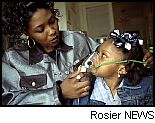
Five-year-old Quinisha has been hospitalized six times, placed in intensive care once and rushed to the emergency
room on more occasions than her mother can remember. The little girl has severe asthma, diagnosed when she was just a
month old.
Now there's hope that in the future, other children won't have to suffer as
Quinisha does: A new study coordinated by Columbia University researchers
and local community groups is monitoring how and when allergies linked to asthma first strike.
Last month, the team unveiled stunning preliminary data: Common allergens can start sensitizing a baby's immune system even before birth.
The data may one day help explain why asthma can strike newborns as it did Quinisha.
The researchers also are spearheading a "Healthy Home, Healthy Child" campaign. It's designed to spread the word to parents and
families on how to reduce many allergens and other harmful home toxins like pesticides, metals (including lead) and bad air.
ASTHMA ON THE ATTACK
Asthma rates jumped 78% between 1980 and 1993 and hit New York children hard: They go to the hospital three to five times
more often than other young asthmatics in the United States, says the city's Department of Health.
Those living in northern Manhattan and the South Bronx are affected the most. In 1997, children in East Harlem were
hospitalized for asthma five times more often than those from the upper West Side or Murray Hill.
Yet no one actually knows what causes asthma, notes Dr. Jean Ford, director of the Harlem Lung Center. One clue: 75% of
asthmatics also have allergies. "We asked, 'What are our babies
and infants being exposed to?'" Ford says.
Last year, researchers at the Columbia Center for Children's Environmental Health joined with a community advocacy group,
West Harlem Environmental ACTion Inc. ( WE ACT ), to track the earliest exposures to asthma-linked allergens such as certain pests,
pesticides and cigarette smoke. They monitored the air breathed by 560 pregnant mothers and,
later, tested the mothers' blood and the leftover blood in the newborns' umbilical cords, looking for molecular changes that
indicate allergic sensitization.
More work needs to be done, but early results showed widespread exposure among the mothers to pesticides. Many of
the unborn babies had developed sensitivity to air pollutants and allergens. The cord blood had markers for secondhand smoke,
though none of the mothers smoked. This is bad news for the mothers, but worse still for their babies:
Children are at special risk from allergies because their immature immune systems are least able to cope with environmental irritants,
says Dr. Frederica Perera, head of the Columbia Center. Many allergens are indoors, where city youngsters spend more than 93%
of their time. Also, because children are small, they live and breathe close to the ground, cheek by jowl with heavy fumes, smoke,
insect particles, pets, pesticides, mold, dust mites, lead and mercury residues.
Experts blame the older buildings common in northern neighborhoods for high concentrations of these substances,
especially if they are badly maintained. Also suspect is air pollution in general: Six of Manhattan's eight bus terminals are above 98th
St., notes Peggy Shepard at "WE ACT". Also, urban blight can itself have an toxic effect, says Dr. Mindy
Fullilove, a psychiatrist and expert in community health at Columbia.
Any fire can unleash irritant-filled soot and create blistered, flaking
paint. But if landlords are slow to address the damage or, worse, don't make repairs at all — common in economically deprived
areas — residents will leave and the community as a whole suffers. Too often, the result can be a neighborhood atmosphere that
makes those who remain fearful, stressed and more vulnerable to illness.
TOXIC ALERT
Getting the word out about dangerous substances — both asthma-linked allergens and toxins that can harm a child's mental
or physical development — can work, says Columbia's Dr. David Evans. Even 15 years ago, the danger of lead poisoning was not
as widely known as it is today; thanks to education campaigns, 98% of those surveyed last fall by his group knew flaking paint can
bode ill. But few realize just now how insidious the danger can be. In 1992, days after Cordell Cleare's baby, Emmanuel, was born, water
damage from a fire upstairs wrecked her West Harlem apartment. It took years to finish fixing the apartment — and no one told
Cleare that floating in the air were particles of peeling lead paint. By age 3, Emmanuel had more than four times the lead in his
system deemed safe by the federal government. His behavior regressed: He stopped talking and went back to diapers. Cleare
had to seek shelter in a lead-free safe house in the Bronx. Today, Emmanuel, 7, has lead levels within normal ranges, but
remains in special education classes. "I got him the help I could as soon as I could, and he got his speech back," says Cleare, who
now leads a volunteer anti-lead group. "But who is to say what has been lost?"
BE A DUST BUSTER
Some environmental improvements will require local and state legislation, says Shepard. Meanwhile, here's what parents can do
now to make homes safer for their children, born and unborn.
Air Pollution
Secondhand cigarette smoke, diesel fuel and car exhaust.
What It Does :
Increases a child's risk for asthma, allergies.
What You Can Do :
Don't smoke at home or near children, or if pregnant. For
help quitting, call your local chapter of the American Cancer Society.
If someone smokes at your house, open the windows and turn on the fans.
Toxic Metals
Lead and mercury (quicksilver from broken thermometers or rubbed on the floor in ritual purification
ceremonies in some Caribbean immigrant cultures).
What They Do :
Damage the nervous system, brain development and other organs.
What You Can Do :
For MERCURY, the NYC Department of Health advises :
Use safe alternatives for spiritual ceremonial practices.
Don't vacuum, sweep or mop spilled mercury; don't dump
down sinks (it can evaporate and return as fumes).
For small spills (such as the amount in a thermometer):
Wear rubber gloves, collect spills in an eyedropper, place
on a paper towel, seal inside a Ziploc bag; use sticky tape
to collect tiniest droplets. Put dropper, tape, plastic gloves
in sealed bag. Dispose in regular trash. Open windows to
air fumes.
For larger spills, call your State or City's Department of Environmental Protection.
For LEAD, regarding peeling paint in buildings built before 1960,
***Call your local city, town, or village Housing or Building Department.
***Test children in such homes by their 1st birthday.
***Vacuum often.
***Get the water tested.
***Have children wash their hands after playing on the floor.
***Let water run cold before drinking or using in cooking.
(Hot water will draw out lead if it is in the pipes.)
PESTICIDES
Roach, plant and insect sprays, flea and tick shampoos, rat poison, bug repellents ( may be more prevalent this
season because of the West Nile-like virus ).
What They Do :
Can cause allergic reactions or asthma attacks.
What You Can Do :
For rodents, use snap traps or glue boards (placed out of children's reach).
For roaches, use boric acid ( Go to :
"BORIC ACID ROACH KILLER" ) and diatomaceous earth (it has tiny hard shells in it). Boric acid kills bacteria roaches need
for digestion. Diatoms rub holes in the insect's exoskeleton "and then the roach dries out and dies," says Evans. But use
it sparingly: Boric acid has some low toxicity for children. If you must use pesticides, store them out of reach and use
the gel forms instead of the sprays, which children can inhale.
Remove children, toys and pets from any area before using a pesticide.
BUG AND ANIMAL ALLERGENS
( Dust mites, roach particles, mouse urine, rat droppings, pets ).
What They Do :
Can irritate respiratory systems, triggering
allergies and asthma.
What You Can Do :
( FOR MORE INFORMATION, GO TO : "ANTI-ALLERGEN SPRAY" )
Practice integrated pest management —
deny them food, water, shelter and access.
**If you child is allergic to pets, give the pets away. Get rid of
stuffed animals and rugs.
**Tightly bag garbage and get rid of it every night. Put foods
like flour or chips
in sealed plastic or glass containers.
**Repair leaky faucets.
Rodents: Cover holes and other entry points with copper mesh.
Report holes or cracks to the landlord. Throw out rugs: Some mice urinate all the time, "on the
move," says Ford.
Bugs: Fix torn window screens to block mosquitoes. Seal or caulk cracks with putty or even duct tape.
Use plastic mattress and pillow covers and wash bed linens in hot water frequently: This does more to stop dust mites
than vacuuming. Use a damp mop on the floor to reduce dust. Vacuum when children are out: It kicks up dust.
Change vacuum bags on vacuuming equipment on a regular basis.
For advice and help, call:
***Your Local Department of Health
***Your State or City's Department of Environmental Protection
( for dust, air, water, noise and asbestos abatement. )
***Federal Center for Disease Control
( for mold, asbestos, lead ).
TENANTS SICK OF CITY BUILDING
Eying Lawsuit over Toxic Washington Heights Dwelling
Original Publication Date: 8/22/01
By STEVEN KENNEDY and HELEN PETERSON
Daily News Writers
Tenants of a city-owned building in Washington Heights say their homes are being invaded by a sickening combination
of carbon monoxide, toxic mold, lead and sulfur dioxide. A lawyer who represents 38 tenants in the building intends
to sue, argued that the city has an obligation to provide a safe environment for the
people who live there. Instead, he said yesterday, his clients are suffering from asthma, headaches,
memory problems, rashes, dizziness, headaches, nosebleeds , brain damage, and other problems.
Another tenant complained that the stink in the building has been horrible all through the years.
He has had pain in his throat and finds it hard to breathe. ... He keeps going to the
doctor. His doctor can't find the reason for it.

WE'VE GOT KILLER MOLD
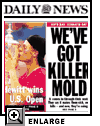
Original Publication Date: 9/10/01
By PAUL H.B. SHIN
Daily News Staff Writer
Ms. Marisol Vargas has been battling a Mold Complex in her Kips Bay apartment for years, and she's at
her wit's end on how to banish the intruder. Like dozens of neighbors at the Henry Phipps Plaza housing complex,
Vargas' home is under siege by black, hairy mold. It has worked its way
relentlessly through her kitchen and bathroom vents, and spread like a dark shadow under the paint on her
bathroom ceiling. "It's everywhere," said Woods' niece, Jenelle Wilkins, 20. " It's just
black mold. You can't scrub it away. You can't clean it up." Next-door neighbor Pearl Johnson, 58, said doctors had detected
mold in her bloodstream.
This mold is responsible for numerous family health problems, including her own memory loss and
severe asthma in her four children, ages 10 to 16. Neighbors have suffered even worse. Just last week, Mattie
Quaily, who also lives at Phipps, charged in a $65 million lawsuit that her daughter was killed by poisonous mold.
Besides Quaily, at least four other families are suing over the alleged wrongful deaths of loved ones.
"A lot of people are really getting sick. It's outrageous," Vargas said.
In all, more than 150 families have sued the management of the 404-unit federally subsidized complex.
The problem of toxic mold has gained nationwide attention lately, especially after a Texas jury awarded a family $32 million in
damages in June. The family sued its insurance company for failing to repair water leaks that could have prevented the spread of
molds, including one called stachybotrys, a type also found in the Phipps complex.
According to court documents, there are nearly 500 tenants suing Phipps for damages exceeding $12 billion.
In these court documents, the building's management has been accused of ignoring numerous pleas from tenants
to stamp out the mold infestation. Court papers also charged that the management "did nothing to notify
the plaintiffs of the danger that condition posed. Lawyers for Phipps have denied any wrongdoing and accused the
plaintiffs of making "sweeping, ill-defined allegations," the court papers show.
They also challenged claims that the mold is responsible for the tenants' health complaints, including headaches, nosebleeds,
chronic fatigue, respiratory problems and, in the case of Quaily's daughter, Lorraine Woods, death at age 58 in October 1998.
Experts say the clinical research on the toxic effects of molds like stachybotrys is not conclusive, but doctors are getting a growing
number of complaints about mold-related health problems, especially among people with weakened immune systems.

THE DANGER OF MOLD IN HOMES
Original Publication Date: 10/7/01
By JAY ROMANO
New York Times REAL ESTATE Writer
( Excerpts taken from an article appearing on Sunday, October 7, 2001, RE pg. 7 )
Mold Spores Can Thrive in Many Places;
Heating and Air-Conditioning Systems are especially Good Hosts.
Mold can cause health problems that range from itching eyes, sneezing, and coughing
to serious allergic reactions, asthma attacks, and even permanent lung damage. And what
many people do NOT know is that mold could be growing in their homes right now.
There are..." houses that are so neat and clean that not even a teacup is out of place"...
"go into the basement and find mold growing on the legs of the furniture" .
"...while mold in a house is most often found on walls, floors, ceilings, carpets, and fabrics
exposed to moisture, one particularly troublesome hiding place is inside the ductwork and associated components
of central forced-air heating and air-conditioning systems...as homeowners start up their central heating
systems many find themselves suddenly coughing, wheezing, and sneezing."
"...while mold needs moisture, oxygen, a food source and a surface on which to grow, a mold
spore in search of a home can come by those essentials relatively easily, even inside a central heating system...
such a system constantly circulates mold spores found naturally in the air through parts of the system
that often have dust on their surfaces...Once a mold spore has embedded itself in that dust--which provides the
nutrients it needs--all the spore needs is moisture. And that moisture...can come from condensation produced by
the air-conditioning coil, from a faulty humidifier attached to the system, or even from high levels of humidity
in the air itself".
"...While it is possible for mold to grow in the ductwork of a central heating system , ...it is more common
to find it in the parts of the system that collect the most dust and have the greatest potential for becoming exposed
to moisture : the air-conditioning coil and its fiberglass lining; and the cabinet that houses the blower fan...coil
linings can be completely infiltrated by mold...and , when the heating system is turned on , the blower fan
distributes mold spores throughout the house. Most people don't even know they have a problem until they start getting
sick."
"In most cases..., the only way to determine with certainty whether mold is growing inside a central heating system
is to gain access to the coil, its lining, and the blower, and take a dust sample from the surface of the components...
That sample must then be examined under a microscope...to see whether there's actively growing mold in the dust."
"The cost of an inspection can range from $200 to $1,000 or more, depending on scope and complexity".
"If active mold is found in the heating system...the homeowner should hire a professional remediation expert--preferable
one certified by the National Air Duct Cleaners Association, a trade group based in Washington--to clean the furnace and ductwork.
Its Web-site is www.nadca.com ...make sure the whole system is cleaned thoroughly...a remediation expert should also clean
the interior surfaces of the ductwork with a brush and H.E.P.A. vacuum".
"If there does NOT appear that mold is actively growing in the heating system, but members of the household have reason to suspect
there is mold elsewhere in the house...additional testing may be necessary".
"...in most cases the most obvious indication of mold in a house is the presence of dark-colored spots on porous
surfaces exposed to moisture. If no obvious signs of mold are visible..., it is possible that mold is growing inside a wall or ceiling.
If you don't see the mold itself, look for signs of moisture...leaks from apartments or appliances on the floor above can saturate the wood,
wallboard and insulation in walls and ceilings, creating an ideal incubator. Determining that mold exists in interior wall cavities...requires
more work".
"In most cases,...small amounts of visible mold on an exterior surface can be removed by scrubbing with a 5 or 10 percent solution of
chlorine bleach in water".
"...a mold clean-up can be costly !"
Copyright © 2001 New York Times.

Hidden Menace
Insurers Worry About Toxic Mold Claims
Original Media Posting Date: 06/26/01
By John McKenzie
ABC News Internet Ventures
Copyright © 2001
THE IMPACT TOXIC MOLD CLAIMS HAS ON THE INSURANCE INDUSTRY !
More and more homeowners are filing insurance claims and lawsuits
over toxic mold, and insurance companies are worried the claims could
overwhelm them.
"The insurance companies thought the asbestos problem was enormous, and this
is going to make that look small," said a public insurance
adjuster. In Texas, several insurance companies have asked the state to allow
them to drop mold coverage from homeowners' policies. Today, several hundred
homeowners showed up at a public hearing on the issue held by the Texas
Department of Insurance. Earlier this month, a Texas jury awarded $32 million
to a woman for what mold did to her 22-room mansion and the mental anguish
she went through. The insurer she sued, Farmers Insurance Group, was among
the companies seeking relief from the state.
Linked to Health Problems
Toxic mold is in millions of homes and offices and schools across the United
States. The term refers to various strains of mold that are blamed for an
ever-expanding list of ailments, ranging from sinus infections and headaches,
to chronic fatigue and even short-term memory loss. "We know these molds can
do these things," said a professor at the Harvard School of
Public Health. "We know it from animal studies. We know it from clinical
studies and occupational settings. "A 1999 Mayo Clinic study found that nearly
37 million Americans have chronic sinus problems because of mold. Mold
usually grows in damp places: behind walls and under floors - wherever there
are wet materials it can feed on. In sitting water, some molds can grow in
just 24 hours.
Drastic Measures
Toxic mold has even forced people to desert
their homes. In Eugene, Ore., the O'Hara family's home became so infested
with mold that they asked the local fire department to burn it down. They
figured that it would be cheaper to rebuild from scratch than try to
eradicate the contamination. "We've got a lot of fond memories of it being our
home," said Mark O'Hara. "Now it's just basically a house that poisoned my
family". Doctors had attributed the family's nosebleeds and headaches to mold
in their home.
Copyright © 2001 ABC News Internet Ventures.
FRUSTRATIONS AND PREVAILING ATTITUDES:
Dear IAQ Onelist Subscribers,
Recently, I received a call from Michelle Conlin, an editor at Business Week
magazine concerning an article she is writing on "SICK BUILDINGS". She wanted
information, especially interviews with people who had been injured on the job.
I thought about all the people I have spoken with over the past few years-
victims, researchers, scientists and hygenists- and then sent an e-mail
to a few people, asking them to contact her if they were interested in responding.
Later, as I thought about yet another article being written about "Sick Buildings" -
I couldn't help wonder if it is all just "yadda, yadda"-going no where and
changing nothing. Another general article about "this is a problem",or,
"it is all in your head" piece which is becoming a sign of our times and NOT
changing a thing. For instance, the parent in Nebraska who wrote us asking for assistance
after her repeated attempts to work with the school district which were not productive.
Why is it that there isn't one governmental agency she can call - just one -who can
answer where responsibility lies for environmental conditions inside a building? It saddens me that
after twenty plus years of research and information gathering, after numerous teachers
leaving their profession from illness and disease and, after many various
articles written by school administrators, teachers and IAQ (Indoor Air Quality)
professionals - it is still the same old story. There is still no clean, clear-cut
procedure to follow when IAQ problems surface in a school. Instead, there is
action, reaction, coverup, name-calling, finger-pointing and other unprofessional
and unproductive behaviors. School districts that have ignored the entire
issue of maintenance, HVAC repair, roof leakage, etc. miraculously go
from unenlightened to "proactive" overnight - at least in the newspaper.
Parents, who are trying to actively work with the principal or school district
are called names - over-reactive, hysterical, troublemakers- and, god forbid
any teachers get involved and talk openly about their own health concerns
or problems or ask that an IAQ committee be established. After a complaint
is lodged, usually outside IAQ consultants are hired by the district who then
control where and when and how sampling will be done. Their results are then the
property of the district and parents are not allowed to meet in an open forum with
the consultants to ask questions and raise issues unless the school district says so.
Some are not allowed to see the report at all. I have a lot of problems with
this system and I know I am not alone in this. Many IAQ consultants have stated that,
when conducting testing, employees have approached them on the sly,
wanting information, having concerns and yet, your hands are tied due to the
ethics and loyalties of who contracted you regarding the testing. Some
of these consultants are asked to conduct their testing after hours, or on
the weekend so no one will suspect what is going on. When we've talked about
how to change this system, some of you have voiced your concerns that many
companies might forego testing at all, if they knew they would have to
meet with employees and divulge the results. In fact, most of you have
probably been put in the situation of knowing that employers are
misrepresenting the results but your hands are tied by contract
from correcting their misstatements. This must be particularly difficult,
especially when the contamination is particularily bad and you have proof
of employees dying from brain and breast cancers and other illnesses.
The bottom line is - THIS SYSTEM ISN'T WORKING. It isn't working for many of
you and it certainly isn't working for the employees. People are being lied
to, their health is being compromised and somehow you need to find a way
to change this - as professionals and we - the parents, victims and others -
need to help you find a way. Having worked in a "Sick Building" where employees
were systematically lied to for years about the IAQ problems, there needs to be
consequences - not excuses. Public employers are by far the worst offenders
because no one wants to take responsibility and be the bearer of bad news -
especially when they have negligently allowed a perfectly good building to
become contaminated by foregoing maintenance, or by allowing roof or other
leaks to continue unabated. I don't know how to fix this situation and make it
more open and equitable, but somehow we need to find a way. In the next
few years we will be facing a teacher shortage, the likes of which we have
never seen before in this country. Until things change, and there is a clear
policy, or law or procedure laid out that guarantees parents and teachers that
school IAQ and their concerns about it are being planned for, continuously
monitored and open to review and suggestions for improvements - I would
counsel teachers to walk away and pursue other careers. Today they are being
cut out of the loop while administrators do an end run around them by hiring
consultants and controlling information. Then, when a major problem occurs -
they are "handled" like disgruntled employees or rabid, hysterical people-who
won't cooperate.
WHAT CAN WE DO?
Barbara Herskovitz
http://www.onelist.com/community/sickbuildings Moderator
A Response to Ms. Herskovitz...
Dear Ms. Herskovitz,
I read your e-mail with great interest and concern; and sensed a great
undercurrent of frustration and anguish regarding the lack of interest towards
"SICK BUILDING SYNDROME" by professional facility managers. Although
you live with these issues on a day-to-day, the actual issues of "SICK
BUILDING SYNDROME" are relatively "new" to the facility industry such
as 'indoor air quality' and 'multiple chemical sensivities'. Besides,
implementation of these policies is NOT presently mandated by law (and
is purely voluntarily); and most facility managers argue that no additional
monies are being provided by management to institute programs of this
kind which are perceived as being more expensive than existing ones.
Please review history, Barbara....changing societal mindsets with imbedded
"old values" takes time. Examine the progress in any major movement in
this country...Civil Rights, Woman's Rights, etc. and you will see that it took
20, 30, 50 years before any actual change took place. Presently, we are
fighting for "Indoor Environmental" or "Building Occupant" rights.
The first step in making any change on an issue is public awareness and
public education. Without awareness, the public at large will not support (or
even understand) the concerns of an issued interest group. First, GOOD
HOUSEKEEPING May 1999 issue and now, BUSINESS WEEK is a great
sign that the mass media is opening its eyes to these issues. These mega-
published magazines would not waste valuable editorial pages on issues
that are non-controversial or of little interest to its readership. It supports
the fact that the average citizen does NOT even know that these conditions
exist, understand its concepts or implications on their own health. "Informing"
and "Education" by any means is a fundamental step to "awareness" which is
a precursor for any ACTION to occur. Believe it or not, magazine exposure
with large circulations is a major accomplishment for fulfilling any objectives
regarding these sensitive issues.
And, things are changing.... As a result of the May, 1999 "GOOD
HOUSEKEEPING" magazine's featured article entitled: "Sick Schools:
Toxic buildings....Is your child safe?", seventeen (17) visionary New York
' Directors of School Facilities' have created and implemented a revolutionary
"HEALTH AND SAFETY" cleaning program seeking "a better way" to maintain
their buildings and benefit the welfare of the students within their districts.
Presently, ALL participating school districts adopting this TOTAL
"environmentally-preferable" cleaning program have removed minimally 8
"toxic" or "hazardous" substances from its cleaning operations or MORE;
reduced 90 % of the different amounts of cleaning products used; created a
NEW "Environmental Guardian" mindset for administrative, departmental,
and custodial staffs towards their indoor work environments ( versus the
conventional janitor or custodian labels ); and improved cleaning standards
through a simpler, easy-to-understand, more practical cleaning program.
As you have probably guessed, I have been involved from the beginning with
developing this program here in New York. Now, you probably think that a
proven, field-tested, cost effective "environmentally preferable" building
cleaning program would be an easy sell. IT IS NOT...it is one of the toughest
challenges in my career so far. Most facility managers that I have interviewed
agree that their # 1 responsibility is: "to provide the healthiest and safest indoor
work environments for their building occupants". Philosophically, they truly
understand where they are suppose to be regarding the political correctness of
"SICK BUILDING SYNDROME". Unfortunately, their philosophical understanding
is NOT in sync with their PRACTICAL approaches to their buildings YET. Here's
the good news: there are approximately 244 school districts in the NEW YORK
METROPOLITAN AREA, including the monstrous New York City Board of
Education who are potential customers to this breakthrough cleaning program.
We have already conquered 17 of them...only 227 to go. Also, a progressive
Director of Facilities (see our JANUARY, 2000 issue: "Indoor Air Quality") has
drafted and received school board approval on his school district's IAQ policy.
Years ago, he did the same for his district's 'Integrated Pest Management'
(IPM) policy. Subsequently, many facility directors statewide used his IPM
policy as a reference to develop their own in their respective school districts.
He anticipates that the same path will be journeyed with his IAQ policy.
Additionally, information gathering and research means absolutely nothing
except to those who do it and/or are interested in it (which is NOT most
of us).
Here is the way to make changes:
1) Legislatively : Create neighborhood Political Action Committee (P.A.C.)
whereby 10 concerned families and/or individuals in an area fund-raise or
donate $100 (= $1000)-Personally, hand-deliver $250.00 donations to both
major candidates of both political parties running for government state houses
(assembly and senate) with a full explanation of the problem, its solution, and
suggested legislation. Have members of your P.A.C. committee according to
their political affiliations get involved with the candidates election or re-election
efforts. All political campaigns run on money and volunteer help. Make sure the
P.A.C. committee member gets to meet and know the candidate through this
process. Re-acquaint the winning candidate with these issues AFTER the election.
MONEY TALKS... EVERYTHING ELSE IS B.S. TO A POLITICIAN-EVEN
GOOD INTENTIONS!!
2) Union Involvement: Educate the leadership of the teacher, custodial, & local
AFL/CIO unions regarding the impact of "Sick Building Syndrome" and the use
of "toxic" and "hazardous" cleaning products has on its membership and their
productivity. New Union contracts can demand improvements in some of these
environmental issues.
3) Encourage MORE constant media attention regarding these issues.
In closing, no one parent or individual can take on an entire
establishment. Remember: YOU CAN'T FIGHT CITY HALL! Many of us
have tried...quite unsuccessfully. Without question, concerned individuals
will be called "over- reactive, hysterical, and trouble-makers". Although
these type of individuals are absolutely necessary to make change in
society, they are also perceived as the unwelcomed "evils" into any
business or school meeting . Unfortunately, Barbara, you can't beat
the system. Even the leadership of the radical 60's knew that you had
to join the system and change it from within. If YOU or anyone want to
change a school system, run for school board and make this issue your
major platform. You may not win...but everyone in that district will be
aware of the issue by election time. I truly believe that patience, fortitude,
and stubbornness will make the difference. Frustration and disillusionment
only works against the true objectives of your cause. If I were the corporate
and school opposition to remedying any of your "SICK BUILDING SYNDROME"
concerns, I would have smiled after reading your letter. Their indifference and
deaf ears are only wearing you down and they hope that you will disappear
and go away. There is an old expression that "PATIENCE IS THE ANVIL OF
THOUGHT". I believe that we just have to patiently outthink them and act
positively towards our ideals each day.
In summary, this complete "HEALTHY & SAFE" cleaning program represents the
MOST sensible program today which delivers results and cost savings against ' toxic
and hazardous' cleaning chemical concerns in the indoor work environment. Presently
these professional school facility directors, in the best interests of their own job
description, should be comparing and challenging any existing or potentially harmful
environmental standards which may impact any child's indoor school work environment .
Until recently, a more environmentally-practical, health-accountable, and cost-effective
program to properly and professionally clean an entire school facility JUST DID NOT EXIST!!
TODAY, alternative environmentally accountable and health oriented facility cleaning
programs DO . Wherever implemented, school facility directors, custodial workers, principals,
teachers, unions and parents have embraced this concept of a healthier and
safer tomorrow.
When interested, we accept the challenge to prove the health and safety benefits of
our cleaning program to any school district, pre-school facility, or university in this country.
Although, you would think that EVERYONE in school facilities would embrace programs
of this type due to its common sense approach and political-correctness, most school
facilities staffers still embrace the more toxic and hazardous products due to familiarity
and custodial preference at the expense of the welfare of the children in their schools. We hope that these concerned professionals
break with this tradition and provide us with the opportunity to demonstrate our viewpoint.
REFERENCES FROM "USING" SCHOOL DISTRICTS ARE AVAILABLE UPON REQUEST. We await your e-mail at :
healthycleanblgs@gmail.com . Visit our web-site: http://www.cleaningpro.com
Responding, somewhere in NEW YORK STATE to you...
Clean safely,
Lauri Halpern
President
HEALTHY CLEAN BUILDINGS
http://www.cleaningpro.com/page.cfm
'HEALTHY CLEAN BUILDINGS'-located at 4 Wilmington Drive, Melville,
New York 11747 (telephone: 631-643-1882; e-mail: healthycleanblgs@gmail.com -is
dedicated to the elimination of existing, conventional "toxic" and "hazardous"
cleaning chemicals in office, school and public buildings; and to advise
homeowners accordingly about our widely recognized and accredited
"HEALTHY & SAFE" Cleaning Program. This revolutionary cleaning system serves
as an effective "environmentally-preferable" alternative to existing, conventional programs. Additionally, this program
addresses controversial indoor environmental issues such as "Sick Building
Syndrome"; "I.A.Q." (Indoor Air Quality); "Multiple Chemical Sensitivities"
(MCS); allergic triggers; respiratory ailments, such as 'asthma'; and other similar ' building occupant' concerns.
LAURI HALPERN, is President and sole owner of "HEALTHY CLEAN BUILDINGS" ® -dedicated to "safe cleaning products that care". As a
mother to two children, she pledges herself to the same high standards of quality and service
associated with this 'healthier and safer' program concept.
Her company- "HEALTHY CLEAN BUILDINGS" ® -has become a mecca for cleaning information on 'Environmentally "GREEN"
Alternatives to conventional cleaning products due to HER involvement
and commitment to these concepts.
STAN HALPERN, Lauri's husband, is an environmental cleaning consultant for over 28 years.
He advises facility directors, professional cleaning contractors, homeowners,and
'do-it-yourselfers' with their cleaning problems each and every day. In fact, he is
one of the few, if ONLY, maintenance supply executives, listed with his accomplishments in "WHO'S WHO IN THE WORLD". As an environmental cleaning consultant, he takes great pride in recommending responsible "environmentally-preferable" solutions to facility managers in commercial, school, and public buildings regarding the healthiest and safest ways to address cleaning and maintenance
problems in their buildings.
 Copyright© 01/5/01 by Stan Halpern





















 By Michael McCagg, Managing Editor